
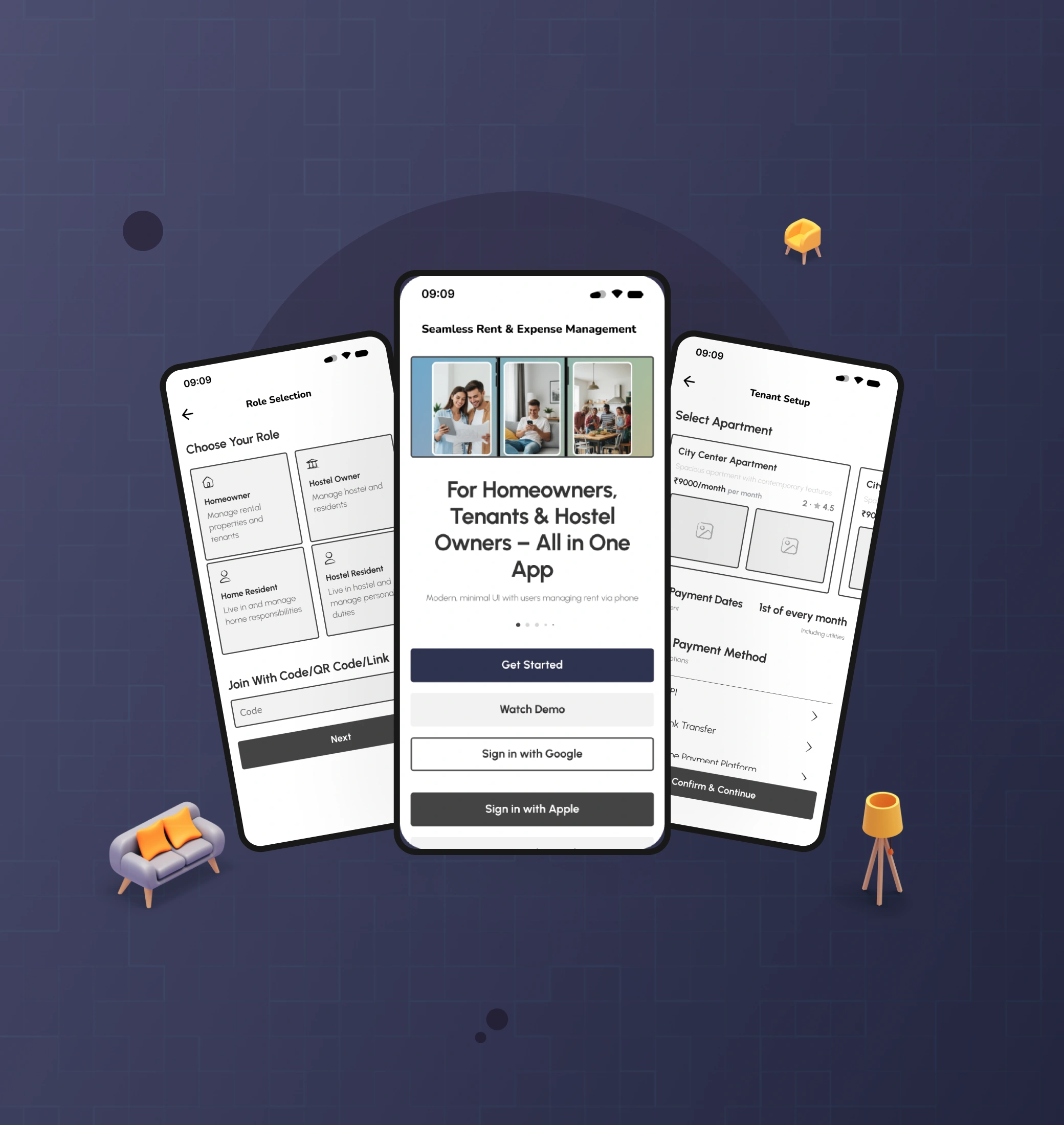
Property management often relies on fragmented tools such as spreadsheets, messaging apps, manual agreements, and informal tracking.
Owners manage rent deadlines, maintenance coordination, and documentation across disconnected systems. Tenants face unclear updates and limited transparency. Hostel owners experience additional complexity due to frequent tenant turnover and shared expense management.
Business and User Goals
The primary objective was to reduce operational ambiguity in rental property management.
Business priorities:
- Improve rent consistency and payment tracking
- Reduce maintenance coordination delays
- Create a scalable workflow that supports multiple properties and tenants
User priorities:
- Clear visibility into rent status and payment history
- Transparent maintenance tracking with status updates
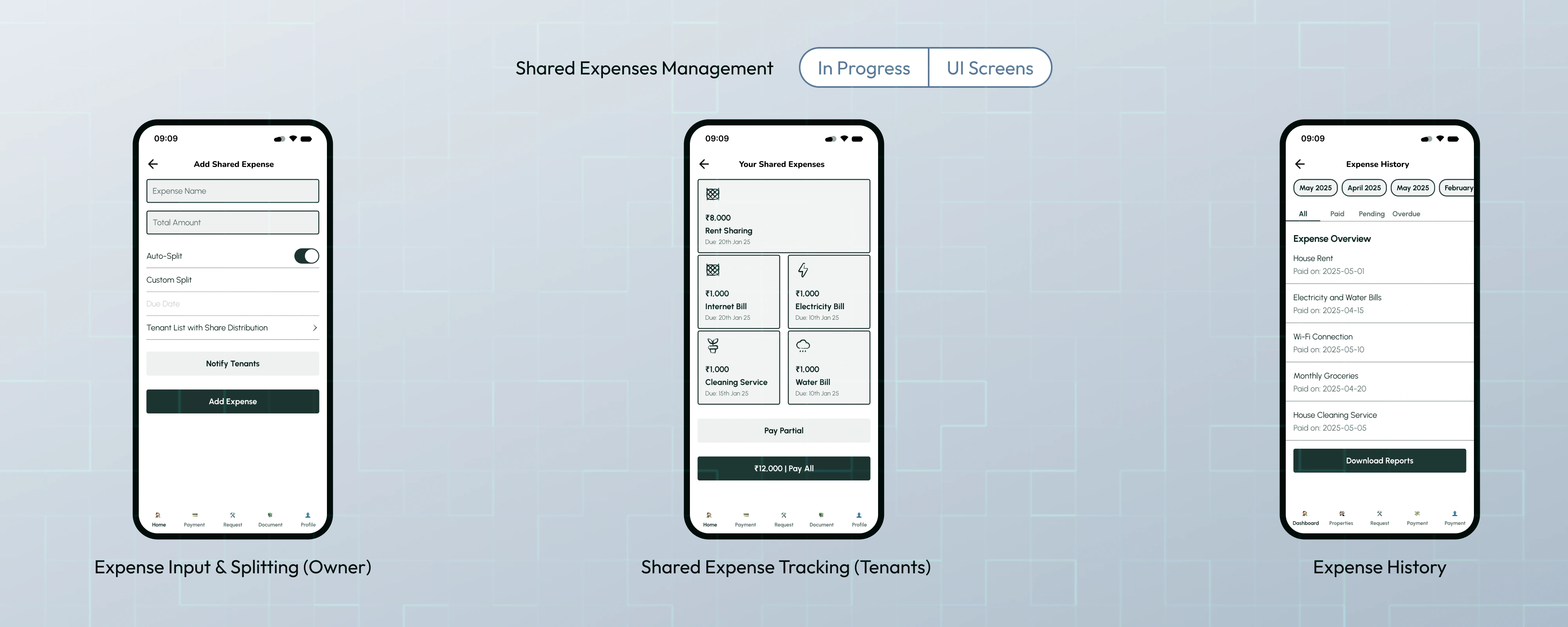
- Easy access to lease documents and shared expenses
A key constraint was balancing simplicity for tenants while preserving operational control for owners.
Problem Statement
Rental management processes lacked defined system states.
Rent collection, maintenance tracking, document handling, and communication operated as disconnected actions instead of structured workflows.
This created:
- Unclear payment accountability
- Delayed issue resolution
- Scattered documentation
- Increased dependency on manual follow-ups
The absence of workflow continuity increased friction for both owners and tenants.
The Solution
TenantEase was structured around connected operational workflows rather than isolated features.
For Owners:
- Centralized property and tenant management
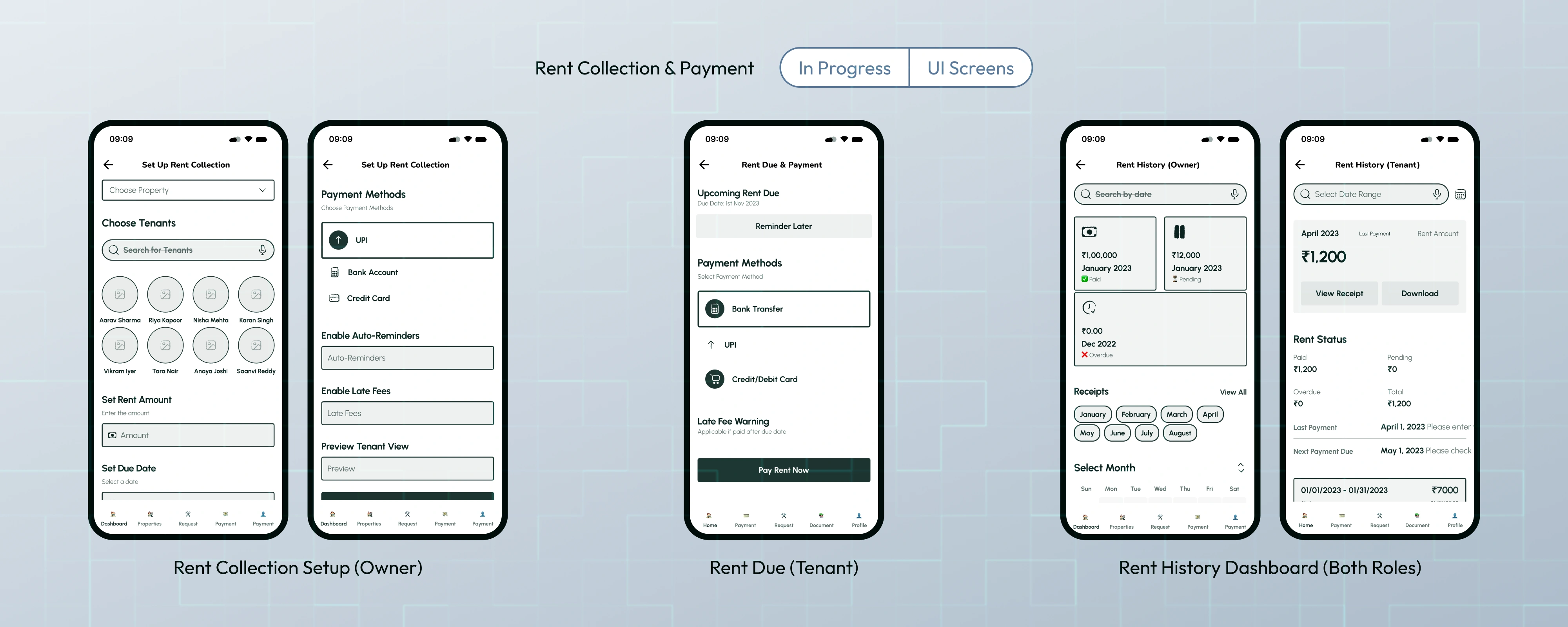
- Structured rent lifecycle with tracking and reminders
- Maintenance coordination dashboard
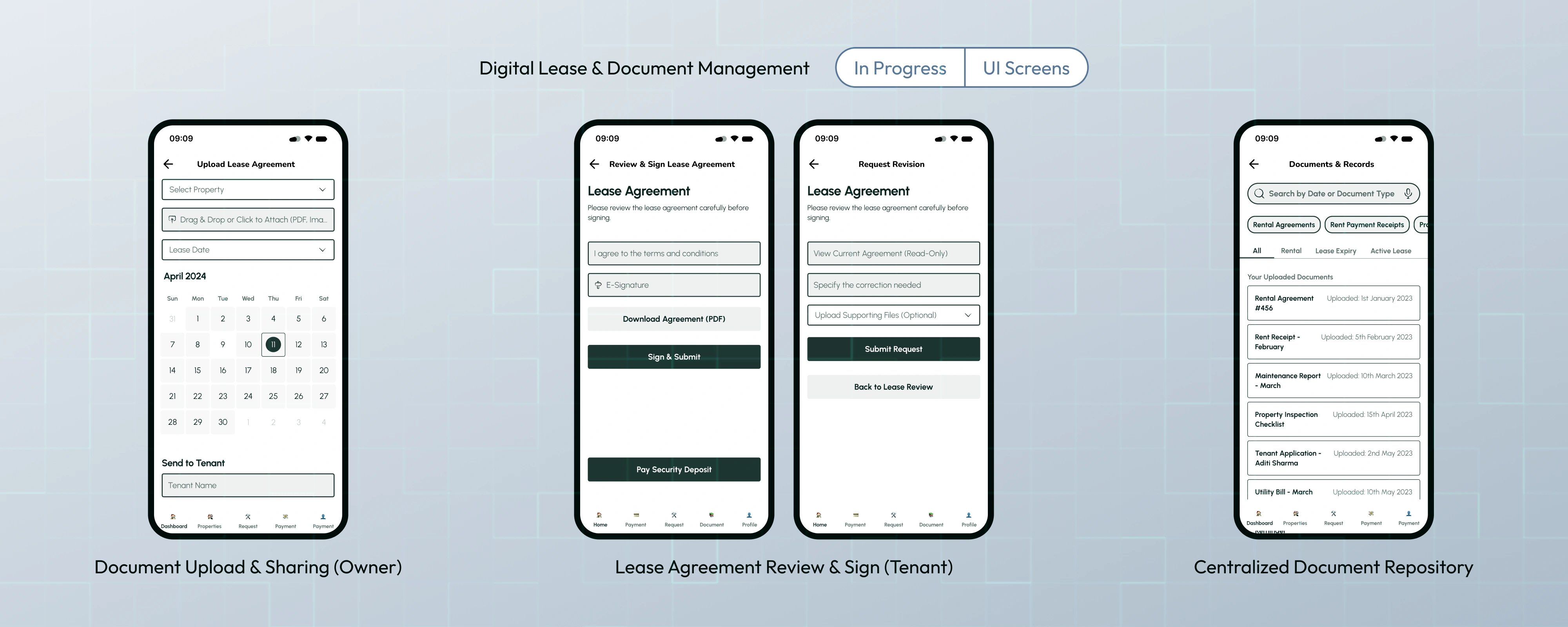
- Document repository with searchable records
- Financial tracking across rent and shared expenses
For Residents:
- Clear rent status visibility and payment tracking
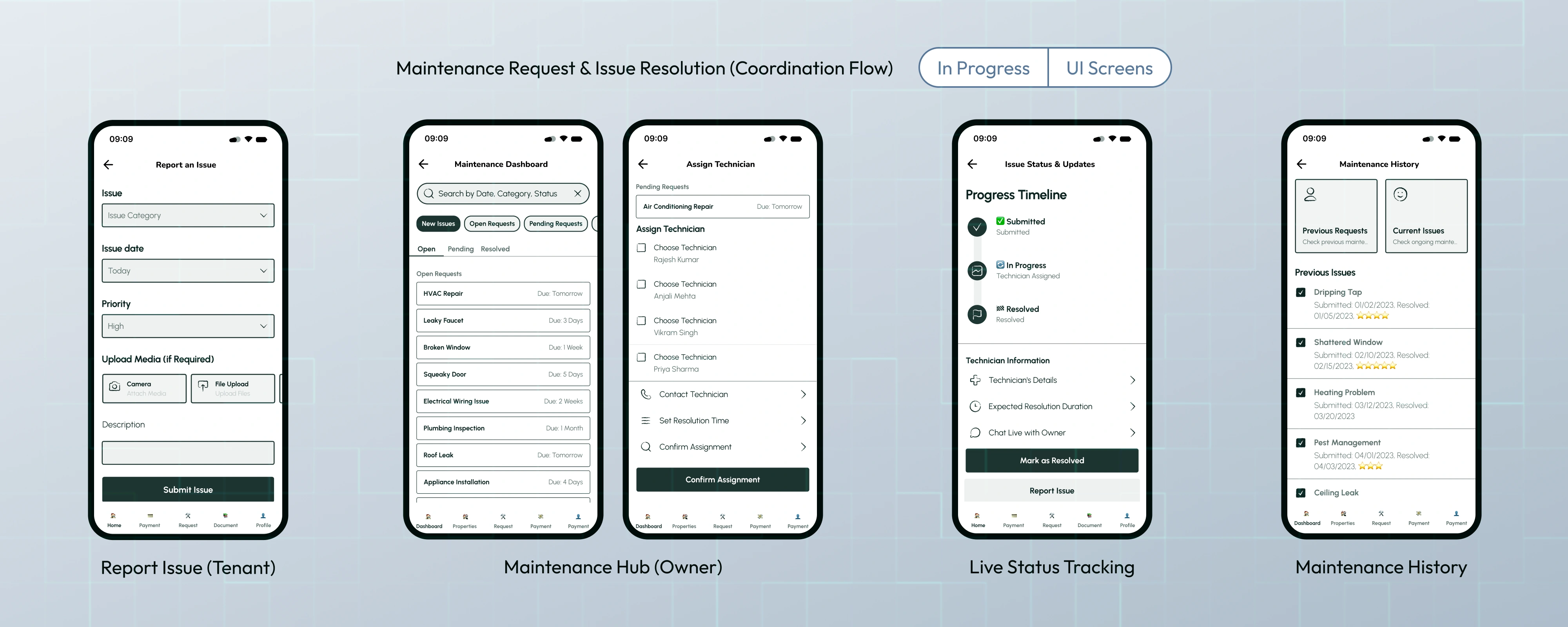
- Maintenance requests with defined status updates
- Access to lease documents and payment receipts
- Notification system for operational updates
The emphasis was workflow continuity and role clarity.
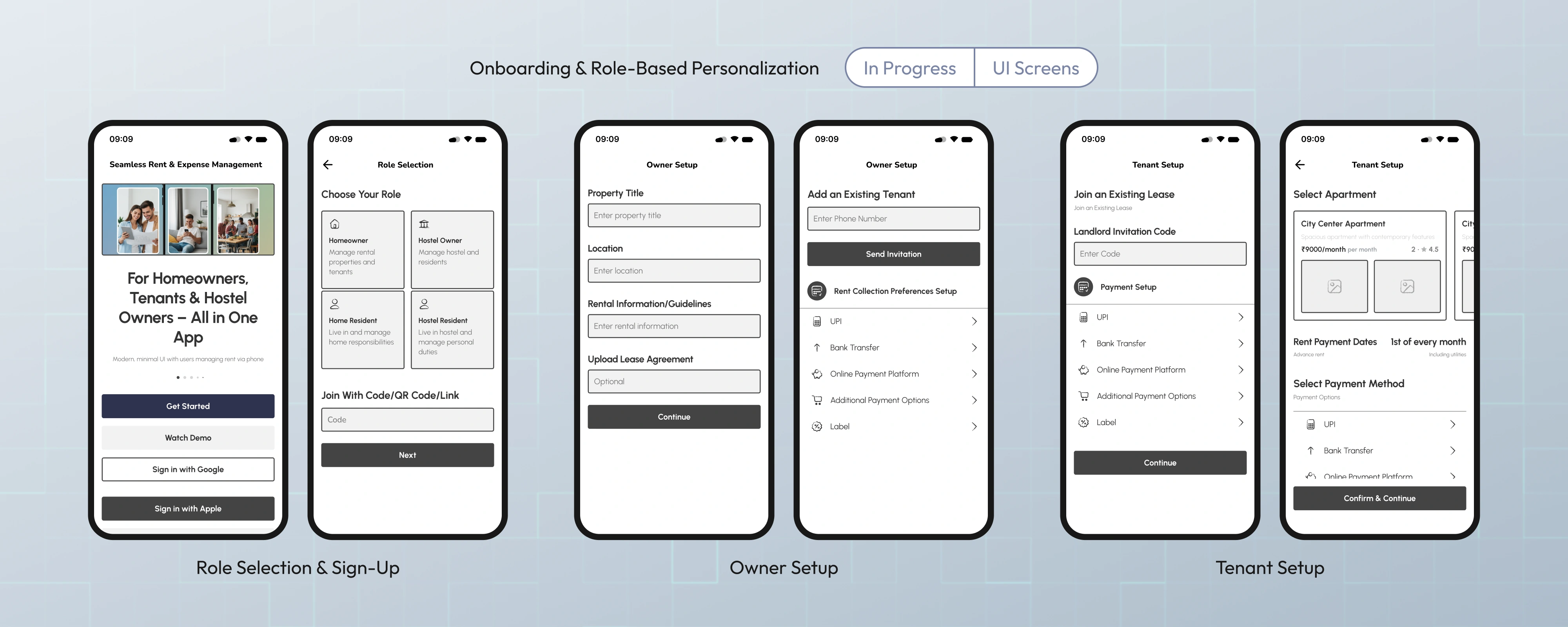
Flows (UI Screens)
Approach
The product was designed using workflow modeling before interface design.
Key steps included:
- Mapping the rent lifecycle from setup to confirmation
- Defining maintenance request states from submission to resolution
- Separating owner and tenant flows to reduce role confusion
- Structuring document handling as a centralized repository system
- Designing shared expense tracking as a transparent split-based system
Wireframes focused on state transitions rather than static screens.
Each interaction was evaluated based on:
- Clarity of next action
- Reduction of manual intervention
- System transparency
Operational Behavior
Before the Solution:
-
Homeowners:
- Use spreadsheets for rent tracking and WhatsApp for communication.
- Store tenant documents offline or in scattered cloud folders.
-
Hostel Owners:
- Struggle with tenant turnover using physical registers or Excel.
- Lack tools for shared expense tracking.
-
Tenants (Home & Hostel):
- Face delayed rent reminders and untracked maintenance requests.
- Lack access to lease agreements or receipts.
Results
- Introduced structured workflow states across rent, maintenance, and documentation.
- Reduced reliance on external messaging platforms for operational coordination.
- Improved transparency in rent tracking and issue resolution visibility.
- Established a scalable architecture supporting future enhancements such as automated reminders and payment gateway integration.
Feedback and Iteration
Positive Feedback:
- Owners appreciated automated rent tracking and reminders.
- Tenants valued real-time updates for maintenance requests.
Challenges Identified:
- Enable flexible rent payment frequency options.
- Integrate auto-pay feature with reminders before deduction.
Constraints
TenantEase was developed within realistic operational and product limitations:
- No centralized rental data infrastructure across properties
- Diverse user types with varying technical literacy
- Informal rental agreements and non-standard documentation formats
- Dependence on manual payment methods during early rollout
- Need to balance tenant simplicity with owner-level operational control
- Limited integration with banking and payment gateways in initial phase
The product needed to introduce structure without overwhelming users or requiring major behavioral shifts.
Key Trade-offs
Deliberate trade-offs shaped the system architecture:
- Prioritized structured workflow states over highly customizable processes
- Focused on operational clarity before adding advanced analytics
- Chose centralized visibility instead of modular third-party integrations
- Limited automation in early phase to preserve transparency and control
- Designed for small to mid-scale property operations before enterprise expansion
The objective was stability and predictability before feature depth.
Scope Decisions
To maintain focus and deliver a cohesive workflow system, the following were intentionally excluded:
- Automated accounting and tax compliance modules
- Predictive maintenance using AI
- Full-scale CRM capabilities
- Enterprise-level multi-property management controls
- Advanced financial forecasting dashboards
- Deep booking engine or marketplace functionality
This phase focused on building a reliable operational backbone rather than expanding into adjacent ecosystems.
Conclusion
TenantEase reflects system-first product thinking applied to rental operations.
By prioritizing workflow continuity, defined states, and role clarity, the platform reduces operational friction and builds a foundation for scalable property management.
The project demonstrates structured decision-making beyond interface design.