
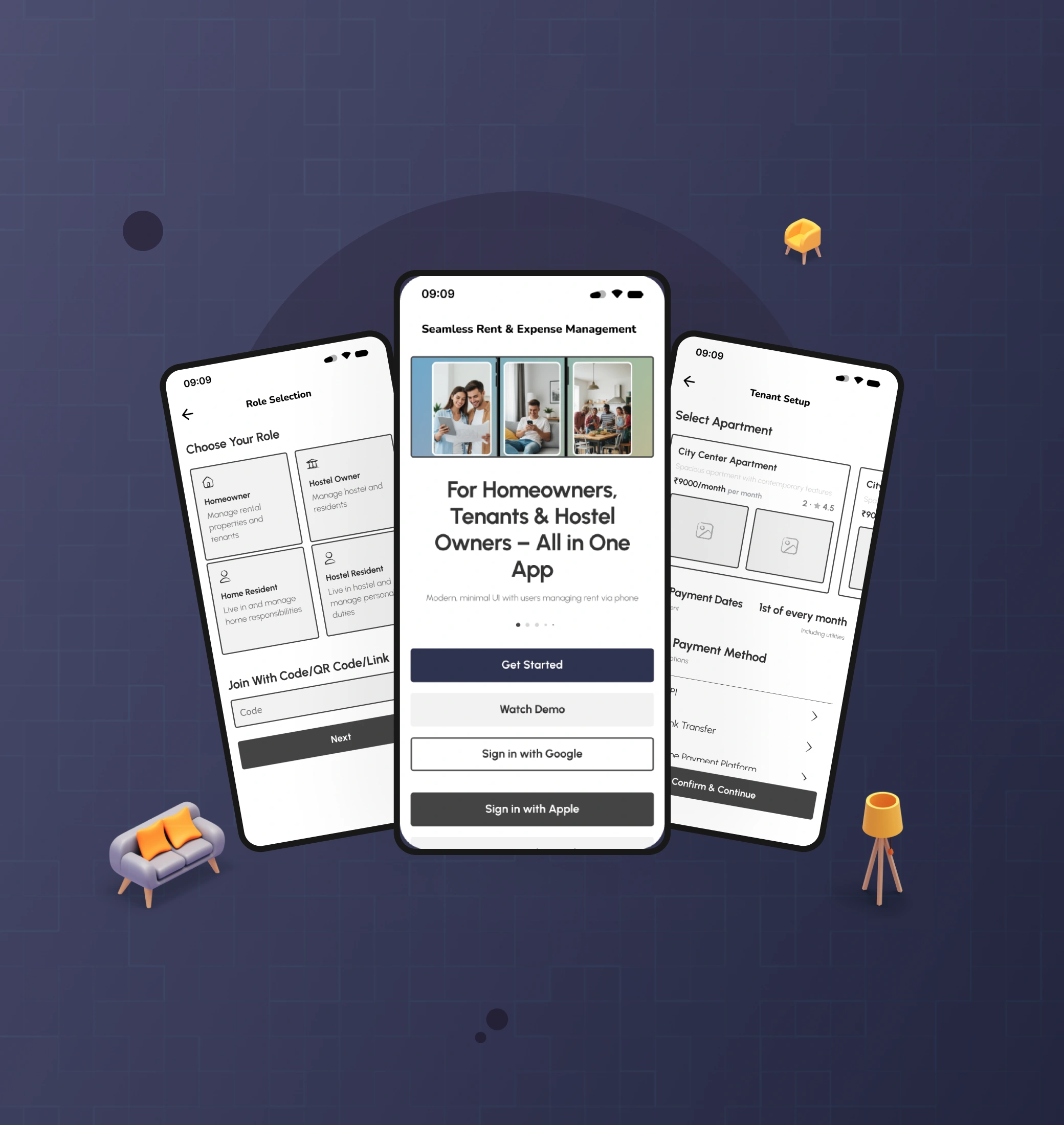
Context / Why
TenantEase is a rental operations product designed for environments where ownership, residential routines, and payment responsibilities are shared across multiple people and property types. The core challenge was not just managing rent; it was helping different stakeholders understand who was responsible for what, what was due, what was pending, and where the information lived.
In many rental setups, the day-to-day work is spread across WhatsApp threads, spreadsheets, scattered PDFs, and informal conversations. Owners need clarity on updates, payment status, and maintenance requests. Tenants need a clear view of dues, lease documents, and issue progress. Hostel operators and residents also need a system that can separate personal accountability from shared obligations.
The product needed to reduce operational friction without forcing users into a complex workflow at the very start. My role was to shape the product around the actual decision points in a rental lifecycle: onboarding, provisioning, payment, maintenance, shared expense tracking, and document access.
Product / User Ecosystem
The product connects several distinct roles that have overlapping but different needs.
- Homeowner / Property Owner — cares about rent collection, maintenance visibility, document control, and the overall operational health of the property.
- Tenant / Resident — wants clear dues, transparent payment history, easy maintenance reporting, and secure access to lease and payment records.
- Hostel Owner — manages a higher volume of shared responsibilities, occupancy changes, and recurring payment tracking across multiple residents.
- Hostel Resident — needs a simpler, more immediate view of shared expenses, due dates, and service requests without needing to interpret a broad admin interface.
The underlying idea was to build a single system that supports different mental models without creating role confusion. Owners and tenants should not be looking at the same information in the same way; they should be guided through different paths based on the responsibility model that fits their role.
Key Product Flows
1. Onboarding & role-based personalisation
Problem: A shared rental platform can become confusing when every user sees the same interface, even when their responsibility is different.
Design thinking: The onboarding experience needed to orient the user quickly around their responsibilities and set clear expectations from the first screen.
Key decisions: Role-led entry points, a simplified account setup, and a cleaner first-run experience designed to reduce cognitive load. The product avoided overloading new users with all features at once.
Screens:
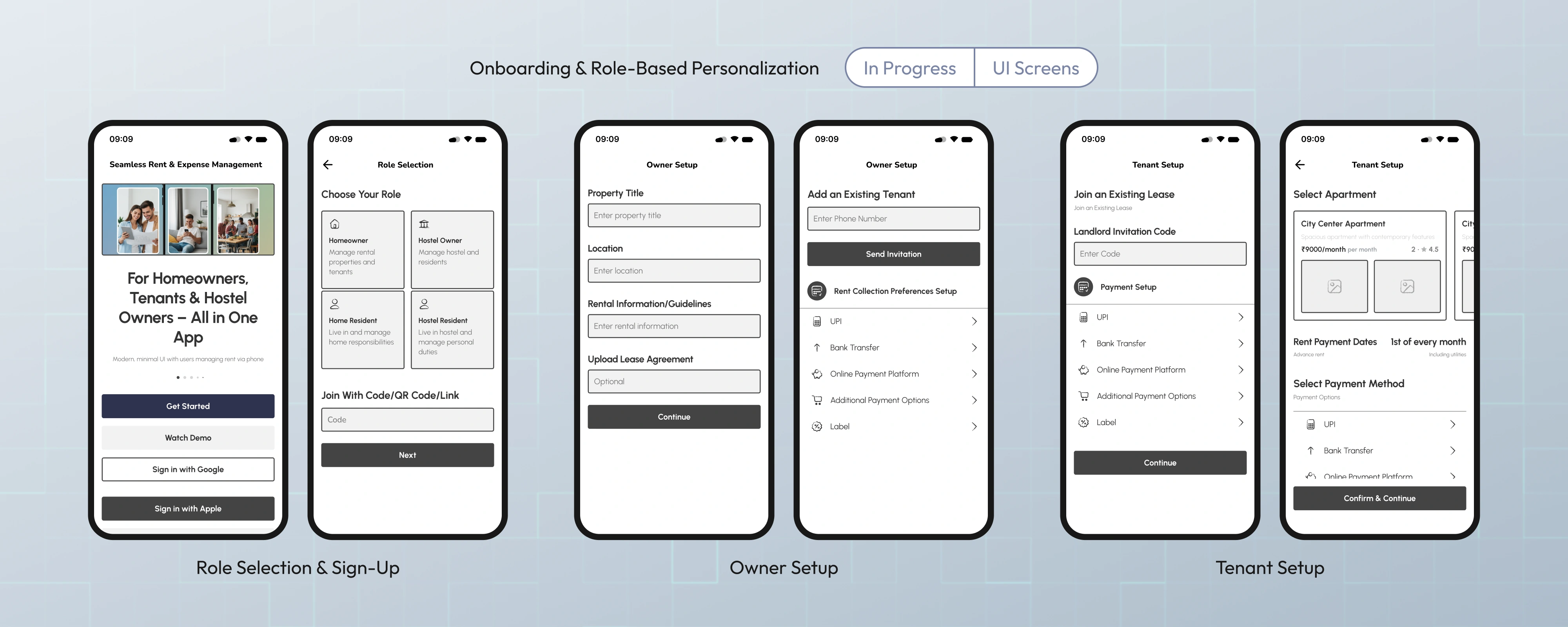
Outcome / learning: A user should understand whether they are managing rent, paying rent, or keeping track of shared obligations without needing training to navigate the product.
2. Rent collection & payments
Problem: Rent information was fragmented and often lived in messages, reminders, or manual spreadsheets. This made dues, receipts, and due dates harder to verify.
Design thinking: Instead of treating rent as isolated monthly admin, the flow needed to show a clear lifecycle: due date, status, payment action, and history.
Key decisions: The design prioritised clarity over novelty. Payment states were structured so that users could quickly tell what was pending, what was paid, and what needed attention. The interface also reduced the amount of interpretation required from both owner and tenant.
Screens:
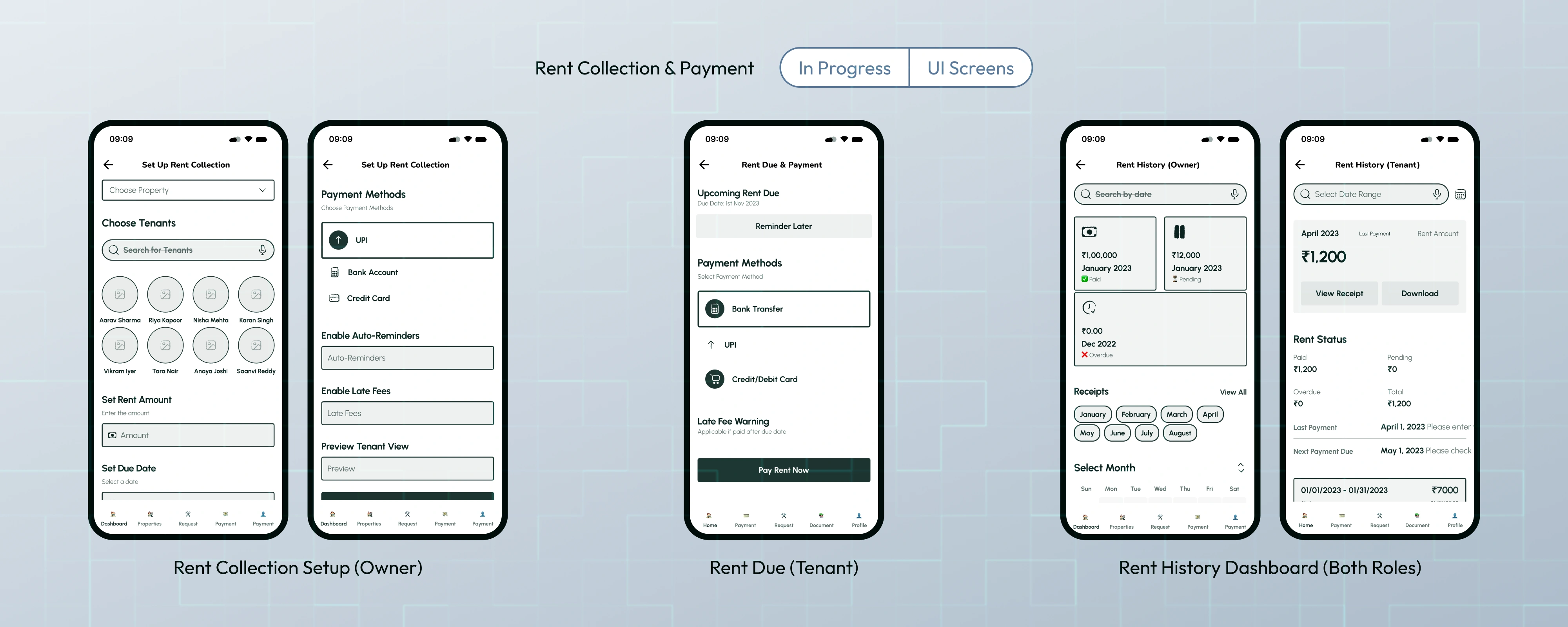
Outcome / learning: Even when the business logic is simple, payment flows benefit from strong status visibility, transparent history, and clear ownership of action.
3. Shared expenses management
Problem: Shared obligations can become awkward when they are not tracked centrally. Residents often remember the expense but not who owes what, or when it was last settled.
Design thinking: Shared expenses had to feel like a natural extension of the rental relationship, not a separate finance feature that was disconnected from the property record.
Key decisions: The screen set focused on clarity of split, settlement status, and accountability, while avoiding overly complex accounting jargon. The goal was to make a shared expense understandable in seconds, not after a manual calculation.
Screens:
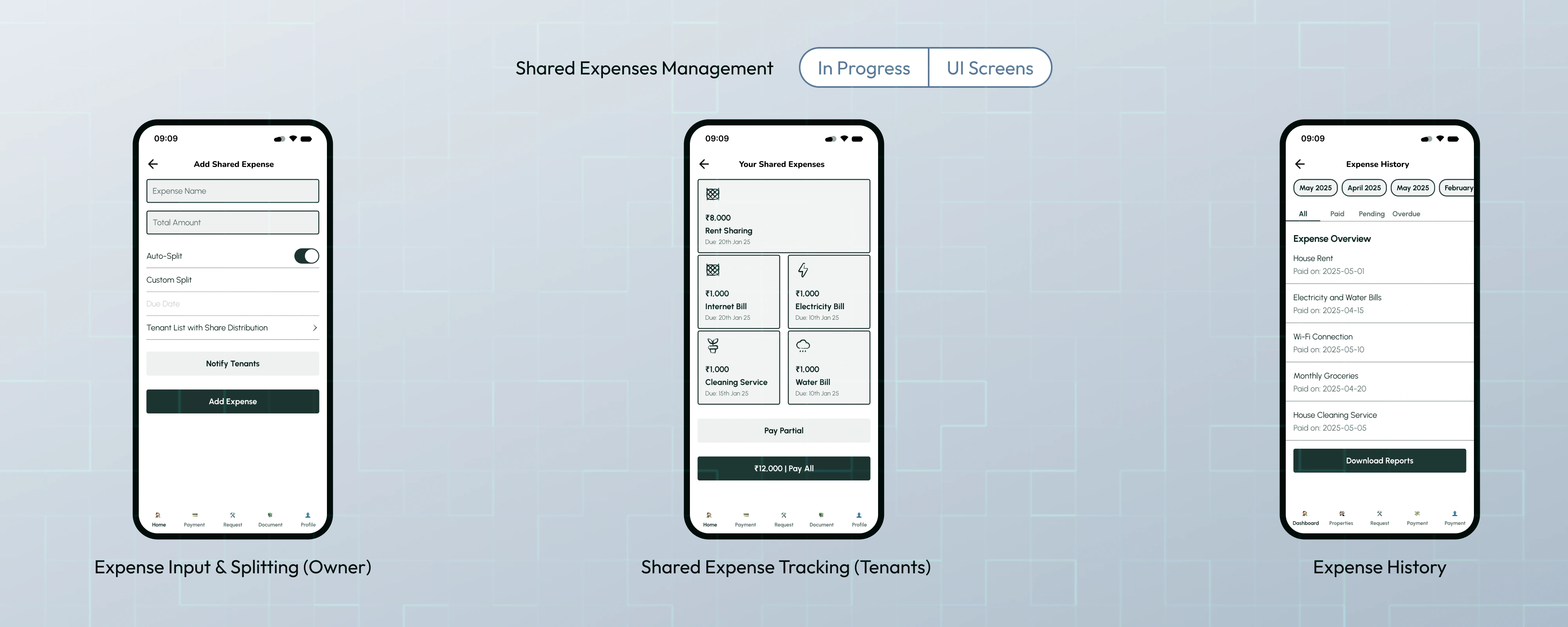
Outcome / learning: Shared financial workflows need to be visible, lightweight, and easy to reconcile. If the system makes people do too much mental math, adoption drops even if the feature is technically useful.
4. Maintenance requests & issue resolution
Problem: Maintenance requests are often lost in chat threads, remembered verbally, or tracked only loosely by the owner. This creates confusion around responsibility and delay.
Design thinking: The product needed a structured issue lifecycle that could show what was reported, who was responsible, what the current status was, and what had to happen next.
Key decisions: The request flow was designed around a clear status progression rather than free-form notes alone. This allowed both tenants and owners to understand progress without constantly chasing updates.
Screens:
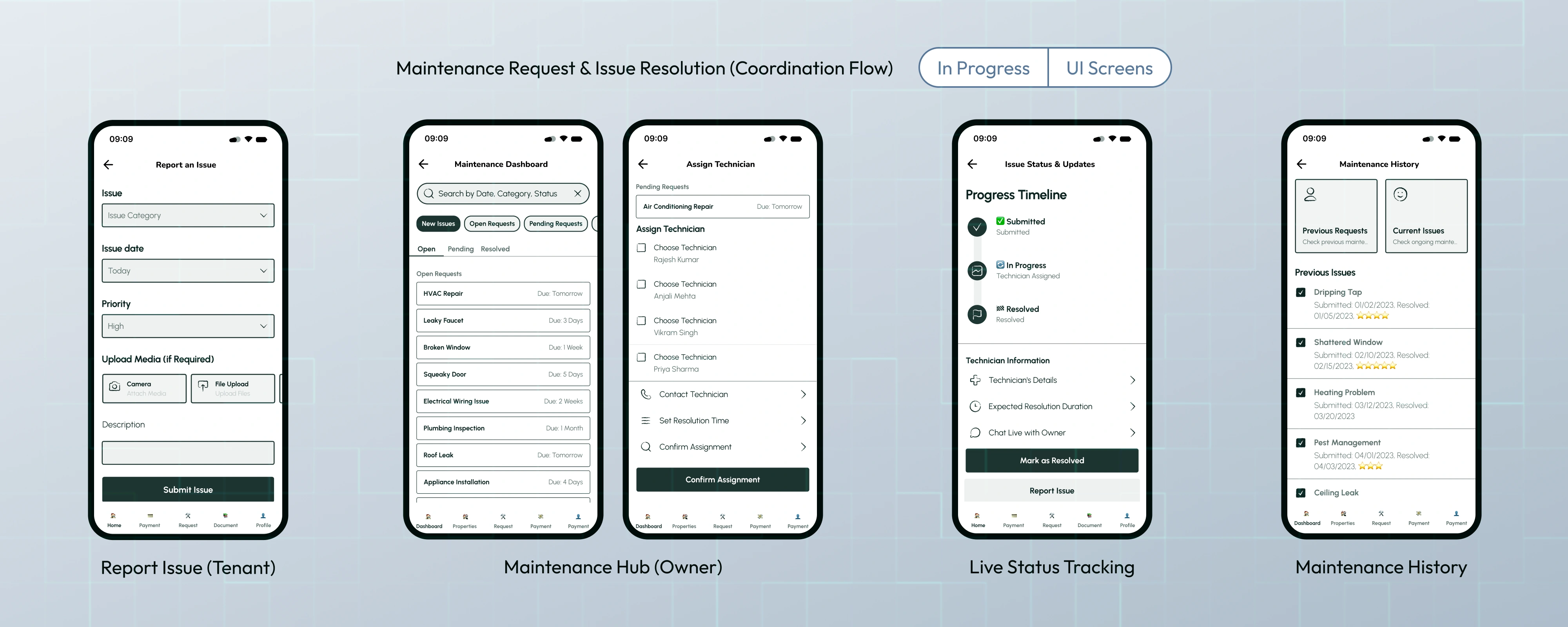
Outcome / learning: A maintenance workflow is only useful when the system makes ownership and progress visible. Without that, users revert to informal follow-ups, which creates more friction than the issue itself.
5. Digital lease & document management
Problem: Lease agreements, receipts, and property records are often scattered across PDFs, email threads, or physical documents. That makes retrieval and verification difficult.
Design thinking: The document layer had to feel like part of the operating system of the rental relationship rather than a separate archive.
Key decisions: The document flow focused on discoverability, security awareness, and simple retrieval. It provided a reliable place to keep agreements and evidence, without making document access feel cumbersome or overly technical.
Screens:
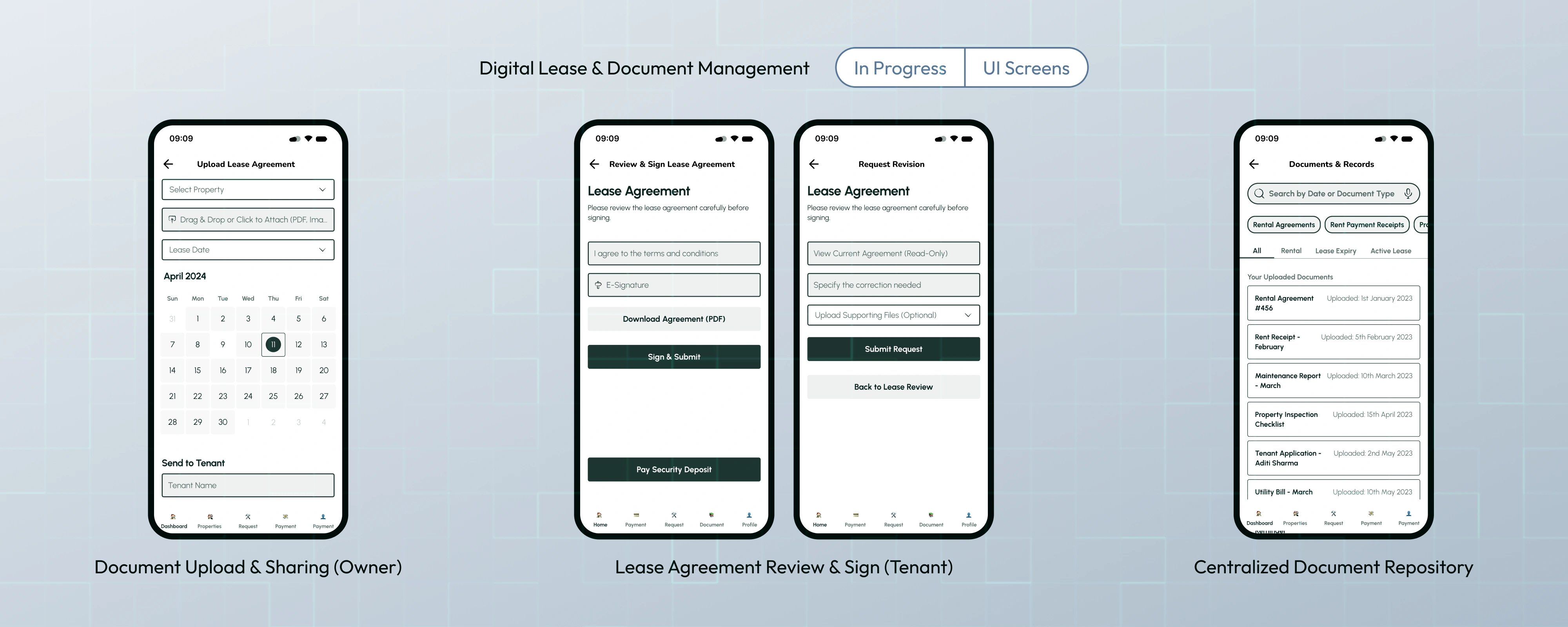
Outcome / learning: A document system works best when it supports the user’s real job: finding the right record fast, understanding its status, and trusting that important information is stored in the right place.
Design Thinking & Decisions
The strongest design decisions in this project were not about adding more features. They were about shaping predictable flows that could carry the same information across different user types without increasing cognitive load.
- What problem was being solved: The product needed to reduce the gap between “what happens in real life” and “what is visible in the system.”
- Why the flow was structured this way: Rental workflows are highly state-based. The interface had to help people understand where a payment, issue, or document was in its lifecycle.
- Important UX decisions: The product prioritised clear status states, straightforward language, and role-sensitive entry points over feature-heavy complexity.
- Trade-offs: The design deliberately reduced customisation in the early version so the core rental experience felt more reliable and easier to trust.
- Edge cases considered: Mixed occupancy, outstanding dues, incomplete record uploads, maintenance follow-ups, and shared responsibilities between multiple parties.
- How the design supports different roles: The experience uses a shared structure but different entry points and priorities for owners, tenants, and hostel users.
- What was simplified or deliberately avoided: Advanced analytics, complex accounting features, and broad automation were left out to keep the product focused on clarity and workflow trust.
What I Learned
This project reinforced a few product-design lessons that were specific to multi-role rental workflows rather than generic UX principles.
- Designing for multiple roles requires different mental models, not just different screens. The same data needs to feel useful in different ways depending on who is acting.
- Complex workflows should be broken into understandable decisions. That matters more than adding more screens or more information density.
- Payment, maintenance, and document flows need strong status visibility and feedback. Without those, users create workarounds outside the system.
- Reusable patterns reduce cognitive load across different user journeys. The more consistent the structure, the easier it is to trust the product.
- Designing the happy path is not enough. Edge cases such as unresolved maintenance, incomplete payment records, or mixed occupancy patterns shape the product as much as the clean path does.
- Ownership matters as much as the action itself. People need to know who is responsible for the next step, not just what the next step is.
What I Would Carry Forward
The strongest parts of this product still feel reusable in future work. These are the principles I would keep and refine.
- What worked: role-based flow clarity, a structured state model, and a consistent visual language across rental operations.
- What I would improve: I would validate assumptions around payment behavior, maintenance intensity, and document habits earlier, especially across informal and semi-formal rental models.
- What assumptions to validate sooner: how users actually communicate around rent, how much they rely on reminders, and what level of documentation is realistically maintained in the field.
- Reusable patterns: status-first interaction design, guided onboarding by responsibility, and structured flows for recurring payments and issue resolution.
- If I had more data or engineering time: I would explore better notification logic, stronger reminders, and more nuanced permission layers across resident, owner, and hostel-management roles.
Outcome / Impact
There were no formal metrics available for this exploration, so the outcome is best described qualitatively.
- Clearer workflow structure across rent, maintenance, and document handling.
- Role-based personalisation that reduces confusion between owner and resident responsibilities.
- Reduced complexity by centralising operational information in a single product pattern.
- Better status visibility for payment and issue resolution without relying on external messaging loops.
- Centralised information for agreements, shared expenses, and property-related actions.
Reflection
This project strengthened my thinking around operational product design. The challenge was not to create a visually polished interface alone; it was to build a system that could support real-world accountability, recurring actions, and different user roles without creating friction or uncertainty.
It reinforced that good product design is not just about making a workflow look neat. It is about making the right decisions visible, reducing ambiguity, and designing for the moments when people do not have the full context. That is the kind of thinking I would continue to bring into future product work.