

Freelancers often rely on multiple disconnected tools to manage projects, payments, and communication. This fragmentation creates visibility gaps, delayed invoicing, and operational inefficiencies.
I led the workflow restructuring, dashboard system design, and lifecycle definition.
Context
Freelancers operate across disconnected tools for invoicing, project tracking, and client communication. This fragmentation directly impacts revenue visibility and creates operational overhead. Freelify consolidates these functions into a structured system with clear lifecycle states and real-time financial transparency.
Problem Statement
- Fragmented workflows across tools
- Manual milestone tracking creates delays
- Payment updates inconsistent and non-visible
- Revision progress difficult to track
- Client conversations scattered across channels
This fragmentation causes missed deadlines, revenue uncertainty, and unnecessary cognitive load.
Approach
Primary Research
Competitor analysis showed that existing tools either fragment workflows across multiple platforms, overload users with unnecessary features, or require complex setup before delivering value. None prioritized daily operational clarity for freelancers.
Workflow Modeling
- Mapped core freelance workflows from project onboarding to final payment.
- Defined clear lifecycle states to structure project progression.
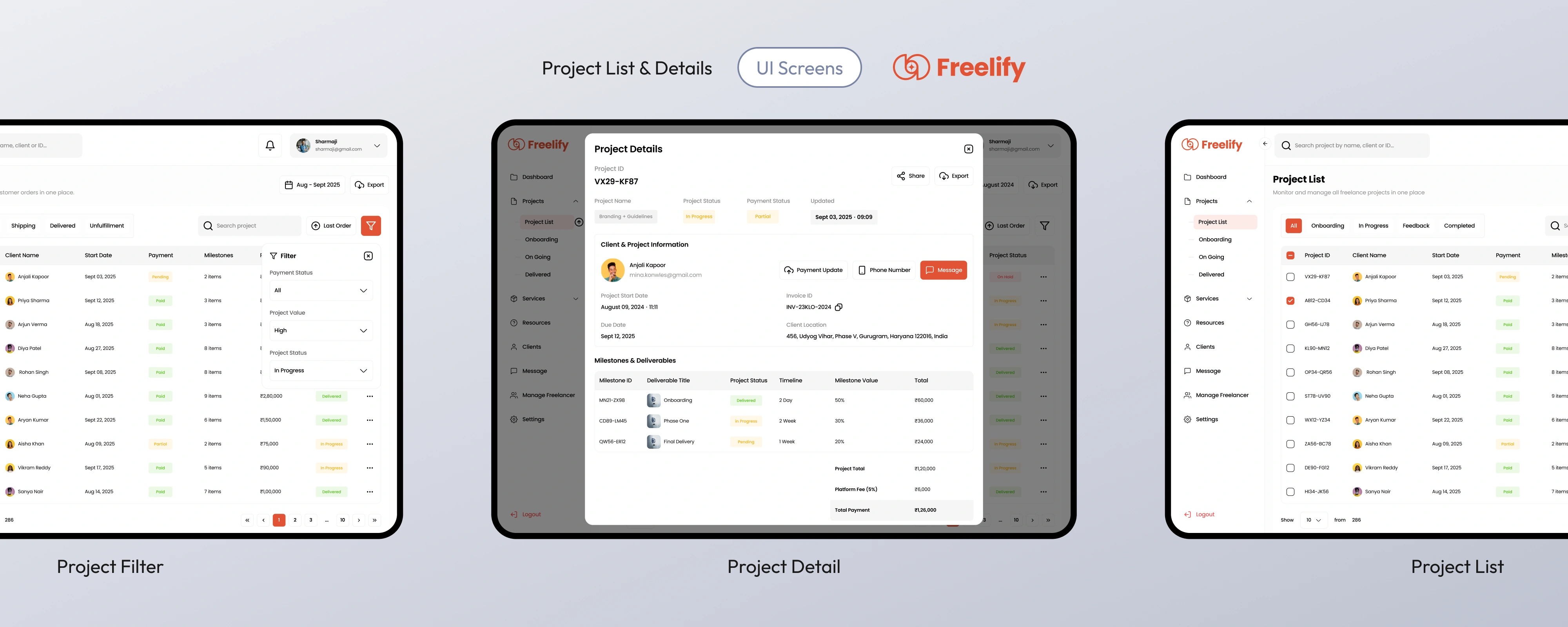
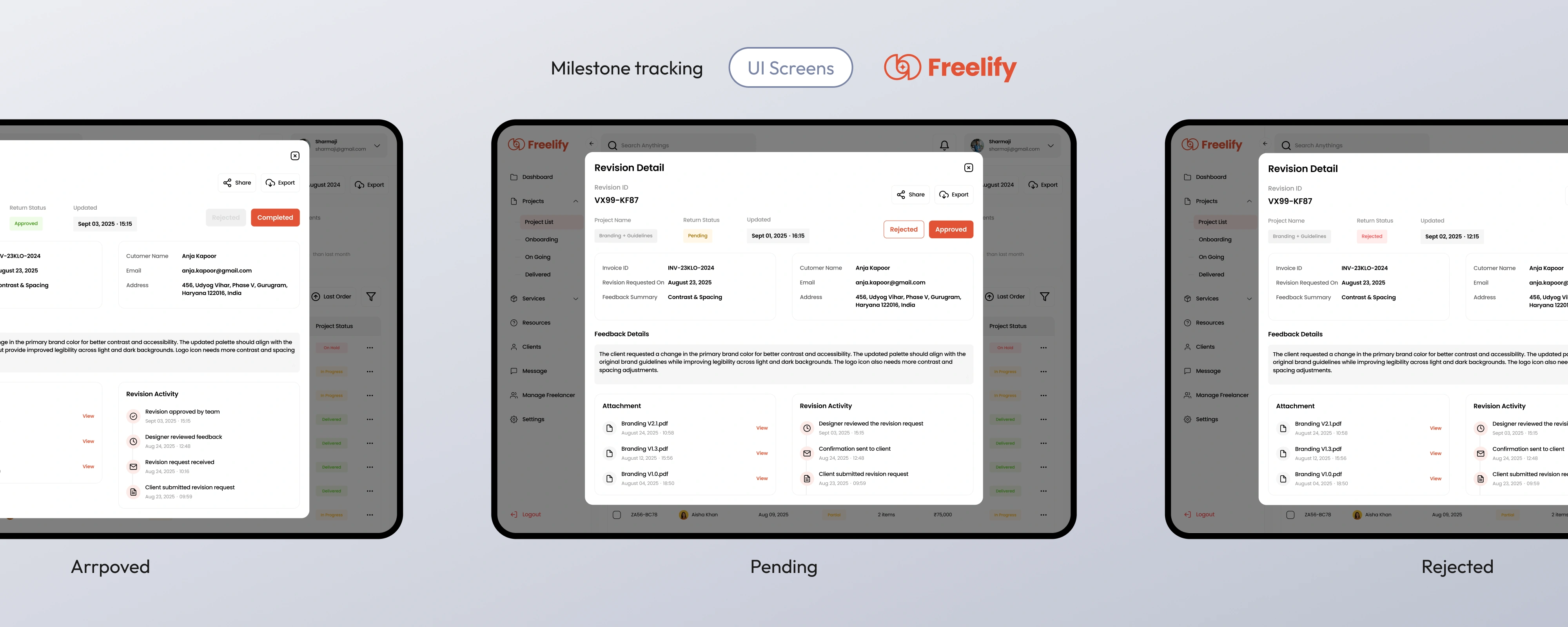
- Centralized milestone and revision tracking to eliminate manual follow-ups.
- Simplified task flows to reduce decision friction and UI noise.
- The focus was operational clarity through structured system states rather than feature expansion.
Constraints
Freelify was designed for independent freelancers without operational teams or structured processes in place.
Key constraints included:
- Users managing multiple tools with low tolerance for onboarding friction
- Need for immediate financial visibility without complex configuration
- Balancing flexible service pricing with structured lifecycle control
- Avoiding feature overload common in freelancer SaaS platforms
The system needed to simplify operations without introducing rigidity.
Flows (UI Screens)
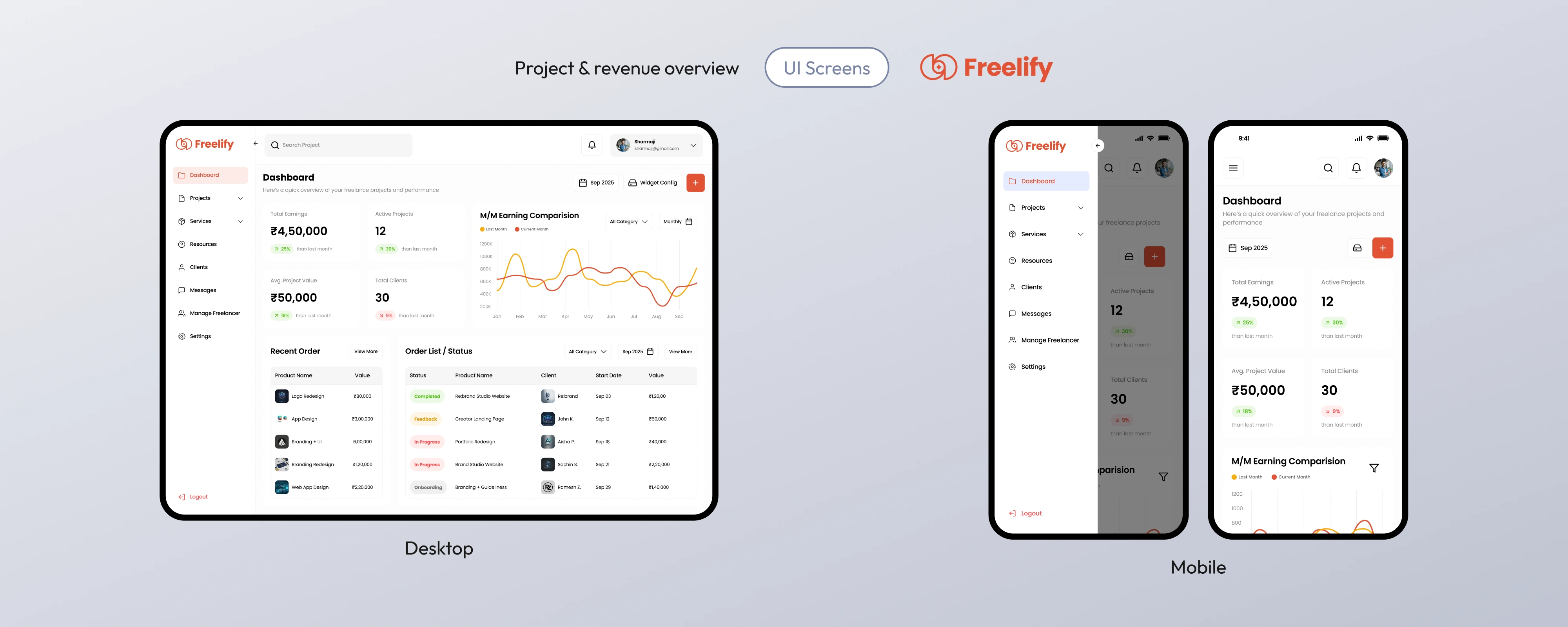
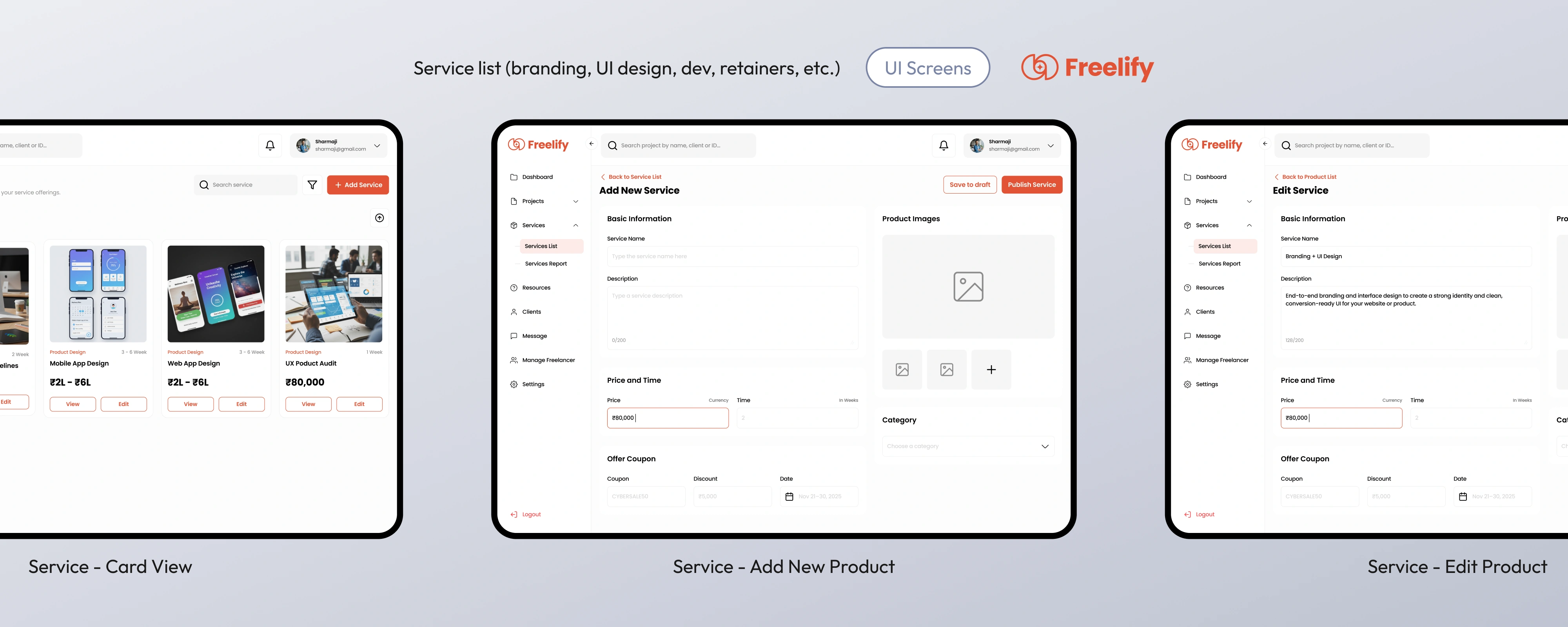
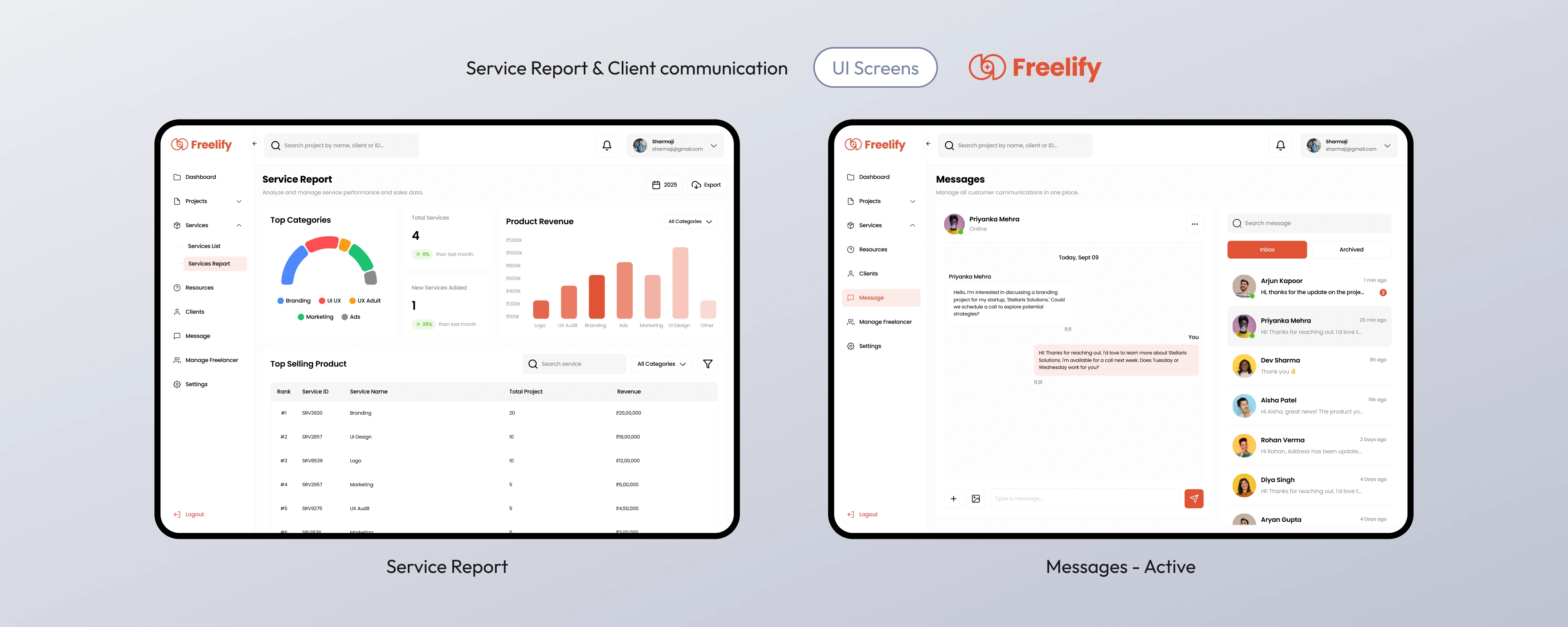
The following screens demonstrate the structured workflow across desktop and mobile covering dashboard overview, project management, milestone tracking, service configuration, reporting, and client communication.
Current Workflow vs. Freelify
Before:
- Multiple platforms for projects, communication, and invoicing. Revenue visibility requires manual calculation.
- Scope creep from inconsistent service definitions and pricing.
- Client updates require manual effort and external communication.
After (with Freelify):
- Single dashboard with real-time project and revenue status.
- Standardized service packages and automated visibility.
- All client communication centralized and auditable.
Impact
- Administrative overhead reduced through workflow consolidation.
- Payment visibility eliminates revenue ambiguity.
- Revision cycles accelerated through automated progress tracking.
- Revenue tracking accuracy improves through centralized logging.
Feedback and Iteration
Positive Feedback:
- Clean, minimal interface focused on daily workflows.
- Messaging and project tracking in one place reduced context switching.
- Service list helped standardize offers and pricing.
Challenges Identified:
- Need flexible pricing and milestone structures.
- Future versions may require basic automation (reminders, follow-ups).
- Integration with booking and payment systems for smoother workflow.
Key Trade-offs
- Chose structured lifecycle states instead of fully customizable workflows to reduce cognitive load.
- Prioritised centralized visibility over modular integrations in the initial phase.
- Limited automation to maintain manual control and transparency for freelancers.
- Focused on workflow clarity before expanding into analytics or financial forecasting.
These decisions were made to establish operational maturity before feature expansion.
Scope Decisions
To maintain focus and ship a stable workflow system, the following were intentionally excluded:
- Automated tax calculations
- Deep financial forecasting dashboards
- AI-based revision prediction
- Third-party booking and payment automation
The objective of this phase was structural consolidation, not ecosystem expansion.
Conclusion
This project demonstrates that operational maturity for freelancers comes from system architecture, not feature volume. By prioritizing structure, clarity, and workflow integration over decorative features, Freelify establishes a foundation that scales with the user's business. The result is a platform grounded in system thinking, built to support real operational scale.